Warning: The magic method QodeInstagramApi::__wakeup() must have public visibility in /home/masg00/public_html/bioenergy.net.au/wp-content/plugins/qode-instagram-widget/lib/qode-instagram-api.php on line 71

Warning: The magic method QodeTwitterApi::__wakeup() must have public visibility in /home/masg00/public_html/bioenergy.net.au/wp-content/plugins/qode-twitter-feed/lib/qode-twitter-api.php on line 91

Warning: The magic method Bridge\Shortcodes\Lib\ShortcodeLoader::__wakeup() must have public visibility in /home/masg00/public_html/bioenergy.net.au/wp-content/plugins/bridge-core/modules/shortcodes/lib/shortcode-loader.php on line 27
Mount Alexander Bioenergy | About BIOENERGY
Warning: Undefined array key "thin_icon_only_font_family" in /home/masg00/public_html/bioenergy.net.au/wp-content/themes/bridge/functions.php on line 144
About BIOENERGY
12
wp-singular,page-template-default,page,page-id-12,wp-theme-bridge,bridge-core-2.6.0,qode-page-transition-enabled,ajax_fade,page_not_loaded,,qode-theme-ver-24.5,qode-theme-bridge,qode_header_in_grid,wpb-js-composer js-comp-ver-6.5.0,vc_responsive,elementor-default,elementor-kit-31,elementor-page elementor-page-12
 

About BIOENERGY

Bioenergy is one of the oldest forms of energy generation available to humans, where organic material is broken down or combusted in order to produce usable energy. In the context of this proposed bioenergy from waste facility there are two complementary forms of extracting energy from waste organic material under consideration: a) biodigester (anaerobic) which consumes wet material, and b) biomass heat plant which consumes dry organic material.


Consistent with the energy flows illustrated in circular economy models, bioenergy draws on both biological (nature provides) and technological (humans develop) pathways.


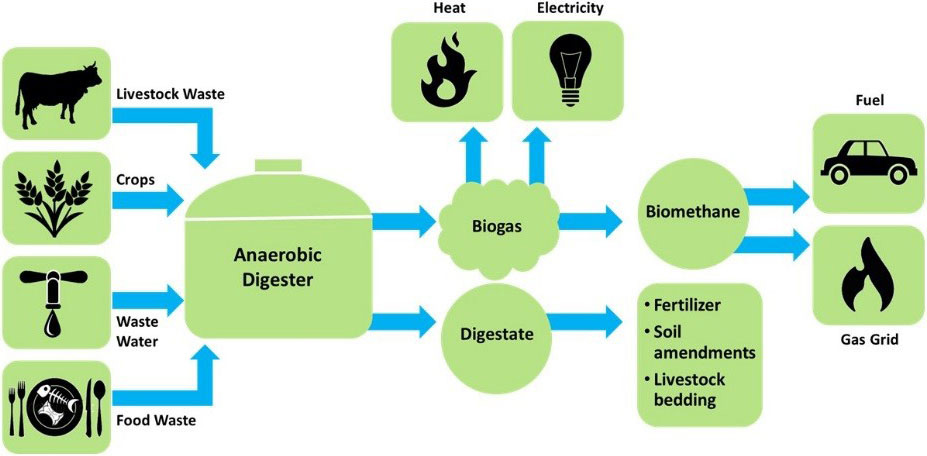
Shown below is a typical resource flow diagram for an anaerobic digester (source: Environment and Energy Study Institute), and images of a biogas reactor (left) and a biomass heat plant (right). An independent LCA study has confirmed the combined emissions avoided by not sending to landfill amounts to circa 88,000 t CO2e p.a.